The Antibody Society

the official website of the antibody society

An international non-profit supporting antibody-related research and development.

  • LOG IN
  • BECOME A MEMBER
  • About Us
    • Our Team
      • Directors and Officers
      • Our Staff
      • Our Committees
    • Sponsors & Partners
  • Events Calendar
    • Current Events
  • AIRR Community
    • AIRR Community News
    • AIRR Community Newsletter
    • AIRR Community Seminar Series
    • AIRR Community Meetings
      • AIRR Community Meeting VIII – Decoding and Recoding Immunity
      • Zooming into the Community III
      • AIRR Community Meeting VII – Learnings and Perspectives
      • AIRR Community Special Event 2023  – Zooming in to the Community II
      • AIRR Community Meeting VI: “Exploring New Frontiers”
      • AIRR Community Meeting V: “Zooming in to the AIRR Community”
      • AIRR Community Meeting V Pre-Meetings
        • AIRR-seq in the Pandemic
        • AIRR-seq Biological Standards and Workflows
      • AIRR Community Special Event: “Response to COVID-19”
      • AIRR Community Meeting IV: “Bridging the Gaps”
      • AIRR Community Meeting III
        • Day 1
        • Day 2
        • Day 3
        • Day 4
      • AIRR Community Meeting II
      • AIRR Community Meeting I
    • On AIRR – An AIRR Community Podcast
    • AIRR Data Commons
    • AIRR-C Germline Database Resources
    • AIRR Community Publications
    • AIRR Community Working Groups
      • Biological Resources Working Group
      • Common Repository Working Group
      • Diagnostics Working Group
      • Germline Database Working Group
      • Legal and Ethics Working Group
      • Software Working Group
      • Standards Working Group
    • AIRR Community Sub-Committees
      • Communications Sub-Committee
      • Executive Sub-Committee
      • Inferred Allele Review Committee
      • Meetings Sub-Committee
      • Strategic Planning Sub-Committee
    • AIRR Community Webinar Series
    • AIRR Community Calendar
    • AIRR Community Resources
  • Programs
    • Conferences
    • Competitions
      • Huston Award
        • Huston Award submission guidelines
      • Research Competition
      • Science Writing
    • Podcast
    • Webinars
      • Upcoming Webinars in 2026
  • Business Intelligence
    • Antibody Discovery & Development
      • Antibody Validation
      • Commercializing Antibody Therapeutics
      • Adaptive Immune Receptor Repertoires
    • Antibody News
    • Antibody therapeutics approved or in regulatory review in the EU or US
      • Antibody therapeutics product data
    • Antibodies to Watch
      • Antibodies in early-stage studies
    • Presentations
  • Learning and Career Center
    • Research Resources
      • Antibodies in late-stage clinical studies
    • Education Resources
    • Society Publications
    • Career Shorts
  • Members
    • Login
    • Note to members
    • Member discount codes
  • Sponsors & Partners
You are here: Home / Archives for Janice Reichert

Crovalimab approved in China

February 8, 2024 by Janice Reichert

On February 8, 2024, Chugai Pharmaceutical Co., Ltd. announced that crovalimab (Chinese product name : 派圣凯®) was approved in the People’s Republic of China for treatment of adults and adolescents with paroxysmal nocturnal hemoglobinuria (PNH) not been previously treated with complement inhibitors. The regulatory application was filed by a China affiliate of F. Hoffmann-La Roche Ltd. because Roche is responsible for the development of crovalimab outside Japan and Taiwan. China is the first country in the world to approve crovalimab. Marketing applications for crovalimab have been submitted to regulatory agencies in the US, EU, and Japan.

Crovalimab (SKY59, RG6107, RO7112689) is a complement C5 inhibiting, humanized IgG1k antibody without effector functions that was engineered (M428L/N434A) to have enhanced affinity to FcRn at an acidic pH to extend its plasma half-life. Based on Chugai’s Recycling Antibody® technology, crovalimab is engineered to bind its antigen repeatedly, enabling sustained complement inhibition at a low dose administered subcutaneously (SC) every 4 weeks. Moreover, crovalimab binds a different epitope of C5 compared to existing antibody drugs, suggesting that it represents an alternative option for patients with PNH with a specific C5 gene mutation.

Crovalimab was granted Breakthrough Therapy for PNH by NMPA and the marketing application for crovalimab, which included data from the China-specific Phase 3 COMMODORE 3 study (NCT04654468), was accepted by NMPA under Priority Review.

COMMODORE 3 was a multicenter single-arm trial studying crovalimab in C5 inhibitor-naive patients with PNH in China. Patients (n=51) received crovalimab according to a weight-based dosing schedule, including loading (intravenous (IV) dose on Days 1 and 4, weekly SC doses starting from Day 2) and SC maintenance doses (every 4 weeks starting from Week 5); treatment continued after 24 weeks in patients with clinical benefit. The co-primary efficacy endpoints of hemolysis control and transfusion avoidance (TA) were met. The mean proportion of participants with hemolysis control from Week 5 through to Week 25 was 78.7% (95% CI: 67.8%, 86.6%).1 The difference between the proportion of participants with TA within 24 weeks prior to screening (0.0%) and the proportion of participants with TA from baseline through to Week 25 (51.0%) was statistically significant (p<0.0001). [1]

The global Phase 3 COMMODORE 1 (NCT04432584) and 2 (NCT04434092) studies assessed the efficacy and safety of crovalimab versus eculizumab in participants with PNH that are C5 inhibitor-experienced patients or not previously treated with complement inhibitors, respectively. COMMODORE 1 assessed safety, pharmacokinetics, pharmacodynamics, and exploratory efficacy of crovalimab. Data from the study support the favorable benefit–risk profile of crovalimab, including allowing for SC administration with the option to self-administer. [2] Data from the COMMODORE 2 study presented at European Hematology Association meeting in June 2023 in Frankfurt, Germany demonstrated that SC crovalimab Q4W was non-inferior in disease control to IV eculizumab Q2W with comparable safety for patients who have not been treated with C5 inhibitors. [3]

  1. Liu H, Xia L, Weng J, Zhang F, He C, Gao S, Jia J, Chang AC, Lundberg P, Camelia S. Sima CS, et al. Results from the first Phase 3 crovalimab (c5-inhibitor) study (commodore 3): efficacy and safety in complement inhibitor-naive patients with paroxysmal nocturnal hemoglobinuria (PNH). Presentation at: ASH Annual Meeting and Exposition; New Orleans, 2022 Dec 10-13; Abstract #293. doi.org/10.1182/blood-2022-162452.
  2. Scheinberg P, Cle D, Edwards J, Giai V, Hus M, Kim JS, Barrenetxea Lekue C, Nagy Z, Nur E, Panse J, et al. Phase III randomized, multicenter, open-label COMMODORE 1 trial: comparison of crovalimab vs eculizumab in complement inhibitor-experienced patients with paroxysmal nocturnal hemoglobinuria (PNH). Hemasphere. 2023; 7(Suppl ): e45540d8. 2023 Aug 8. doi: 10.1097/01.HS9.0000967644.45540.d8
  3. Röth A, He G, Brodsky A, Chai-Adisaksopha CC, Dumagay T, Demichelis R, Höglund M, Kelly R, Lee J-H, Nishimura J-I, et al. The PHASE III, randomized COMMODORE 2 trial: results from a multicenter study of crovalimab vs eculizumab in paroxysmal nocturnal hemoglobinuria (PNH) patients naive to complement inhibitors. Hemasphere. 2023; 7(Suppl ): e72750f1.
Filed Under: Antibody therapeutic Tagged With: antibody therapeutics, approved antibodies

The Antibody Society is hiring!

January 23, 2024 by Janice Reichert

Come join The Antibody Society in our mission to help people involved or interested in antibody research and development. We seek a Marketing and Events Manager to provide expertise in promoting our brand by managing all marketing activities, including managing and promoting events and creating marketing campaigns. This is an opportunity to be a leader in an organization that aids researchers in their development of antibody therapeutics, which improve the quality of life for many. As the Marketing and Events Managers you will take charge of:

  • Marketing for 2 major events annually, coordinating exhibit hall booth and in-person networking events
  • TAbS brand management on social media and website
  • Managing virtual events, including Symposia and webinars
  • Creating targeted marketing campaigns to attract new members and sponsors
  • Coordinating promotional activities with our partners

We seek a highly engaged individual! You are an ideal candidate if:

  •  You are passionate about the purpose and mission of The Antibody Society
  •  You are pro-active, propose new ideas, and have fun at work
  • You enjoy learning new tasks, adapting to new situations, and engaging in collaborations
  •  You value the opinions and viewpoints of others and you express your own opinions

This is a full-time, fully remote position with typical working hours 9-5 PM ET zone with the ability to flex as needed to complete required tasks. The salary range for this role is $75,000 – $85,000 annually. We offer 15 days of paid time off, a total of 12 paid holidays, and a flexible and generous health reimbursement plan.

We ask that applicants have a degree in a related field and at least 3 years of related experience, including managing online webinars, virtual symposia, and marketing at in-person trade shows.

Qualified applicants interested in the position may submit a resume with references to info@antibodysociety.org.

Filed Under: The Antibody Society Tagged With: marketing manager

“Antibodies to Watch in 2024” is now online!

January 5, 2024 by Janice Reichert

In this 15th installment of the annual ‘Antibodies to Watch’ article series, we review commercially sponsored monoclonal antibody therapeutics currently in late-stage clinical development, regulatory review, and those granted a first approval in any country in 2023. We also discuss clinical phase transition and overall approval success rates for antibody therapeutics, which are crucial to the biopharmaceutical industry because these rates inform decisions about resource allocation. Our analyses indicate that these molecules have approval success rates in the range of 14–32%, with higher rates associated with antibodies developed for non-cancer indications. Overall, our data suggest that antibody therapeutic development efforts by the biopharmaceutical industry are robust and increasingly successful.

Download or read the full paper here.

The complete abstract is here: The ‘Antibodies to Watch’ article series provides an annual summary of commercially sponsored monoclonal antibody therapeutics currently in late-stage clinical development, regulatory review, and those recently granted a first approval in any country. In this installment, we discuss key details for 16 antibody therapeutics granted a first approval in 2023, as of November 17 (lecanemab (Leqembi), rozanolixizumab (RYSTIGGO), pozelimab (VEOPOZ), mirikizumab (Omvoh), talquetamab (Talvey), elranatamab (Elrexfio), epcoritamab (EPKINLY), glofitamab (COLUMVI), retifanlimab (Zynyz), concizumab (Alhemo), lebrikizumab (EBGLYSS), tafolecimab (SINTBILO), narlumosbart (Jinlitai), zuberitamab (Enrexib), adebrelimab (Arelili), and divozilimab (Ivlizi)). We briefly review 26 product candidates for which marketing applications are under consideration in at least one country or region, and 23 investigational antibody therapeutics that are forecast to enter regulatory review by the end of 2024 based on company disclosures. These nearly 50 product candidates include numerous innovative bispecific antibodies, such as odronextamab, ivonescimab, linvoseltamab, zenocutuzumab, and erfonrilimab, and antibody–drug conjugates, such as trastuzumab botidotin, patritumab deruxtecan, datopotamab deruxtecan, and MRG002, as well as a mixture of two immunocytokines (bifikafusp alfa and onfekafusp alfa). We also discuss clinical phase transition and overall approval success rates for antibody therapeutics, which are crucial to the biopharmaceutical industry because these rates inform decisions about resource allocation. Our analyses indicate that these molecules have approval success rates in the range of 14–32%, with higher rates associated with antibodies developed for non-cancer indications. Overall, our data suggest that antibody therapeutic development efforts by the biopharmaceutical industry are robust and increasingly successful.

Filed Under: Antibody therapeutics pipeline, Approvals, European Medicines Agency, Food and Drug Administration Tagged With: Antibodies to watch, Antibody drug conjugates, antibody therapeutics, approved antibodies, bispecific, cancer, European Medicines Agency, Food and Drug Administration

Visit us at Antibody Engineering & Therapeutics, Booth #113!

December 8, 2023 by Janice Reichert

The Antibody Society

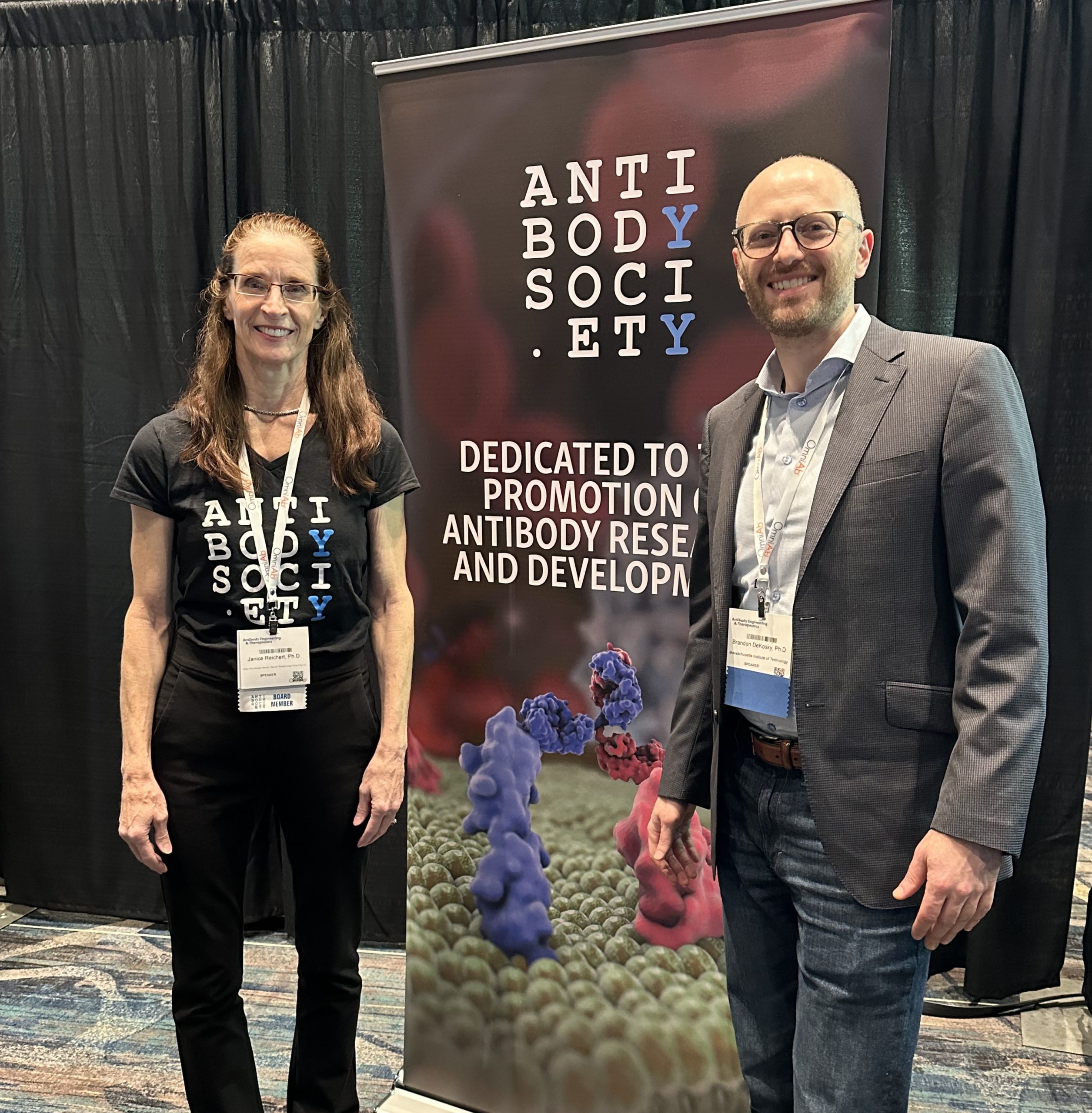
Antibody Engineering & Therapeutics commences on Thursday, December 14, 2023! Visit us at Booth #113 for a free T shirt and networking.

And don’t miss the keynote address by Dr. Heather Bax, the 2023 Huston Award recipient.

See you there!

Filed Under: Antibody Engineering & Therapeutics, Uncategorized Tagged With: antibody engineering, antibody therapeutics, Huston Award

Lebrikizumab (Ebglyss) approved in the European Union

November 17, 2023 by Janice Reichert

On November 17, 2023, Almirall S.A. announced that the European Commission approved EBGLYSS (lebrikizumab) for the treatment of adult and adolescent patients (12 years and older with a body weight of at least 40 kg) with moderate-to-severe atopic dermatitis (AD), who are candidates for systemic therapy. Lebrikizumab (Ebglyss) is a humanized, hinge-stabilized (S228P mutation) IgG4k antibody that targets IL-13, a key mediator of the pro-inflammatory response and enhances neuronal responses to the persistent itch stimuli in atopic dermatitis.

The approval in the European Union is based on results from three phase 3 trials evaluating the safety and efficacy of lebrikizumab in adults and adolescents >12 years of age with atopic dermatitis. Advocate 1 (NCT04146363) and Advocate 2 (NCT04178967) are randomized, double-blind, placebo-controlled, parallel-group studies in which patients with moderate-to-severe atopic dermatitis received either an initial dose of 500 mg of lebrikizumab followed by 250 mg lebrikizumab Q2W, or placebo for a 16-week treatment period. Following the 16 weeks, patients who received a clinical response to lebrikizumab were re-randomized to receive lebrikizumab Q2W or Q4W, or placebo, for another 36 weeks. The primary endpoints were an Investigator Global Assessment (IGA) score of clear or almost clear (0 or 1, respectively) skin with reduction of at least two points from baseline and at and least 75% reduction in the Eczema Area and Severity Index (EASI-75) score. Both Advocate 1 and Advocate 2 met their primary endpoints, with the IGA outcome being achieved in 43.1% of the lebrikizumab cohort (n=283) compared to 12.7% in placebo cohort (n=141) for Advocate 1, and 33.2% of the lebrikizumab cohort (n=281) compared to 10.8% in the placebo cohort (n=146) for Advocate 2. [1] The third Phase 3 study, Adhere (NCT04250337), is a 16-week randomized, double-blind, parallel-group study which investigated the efficacy of lebrikizumab in combination with topical corticosteroids in 211 patients with AD. Patients were randomized 2:1 to receive either 250mg SC lebrikizumab Q2W after an initial loading dose of 500 mg, or placebo, in combination with topical steroids, either mid-potency (0.1% triamcinolone acetonide cream) or low-potency (1% hydrocortisone cream). After 16 weeks, IGA of 0 or 1 with a 2 or more-point reduction from baseline was achieved by 41.2% of the lebrikizumab cohort compared to 22.1% of the placebo cohort, with statistical significance being reached as early as 8 weeks. [2] There was also a significantly greater proportion of patients achieving EASI-75 responses.

Almirall licensed the rights to develop and commercialize lebrikizumab for the treatment of dermatology indications, including atopic dermatitis, in Europe. Eli Lilly and Company has exclusive rights for the development and commercialization of the product in the United States and the rest of the world, not including Europe. Lilly has submitted a marketing application for lebrikizumab for atopic dermatitis to the US Food and Drug Administration.

  1. Silverberg JI, Guttman-Yassky E, Thaçi D, Irvine AD, Stein Gold L, Blauvelt A, Simpson EL, Chu CY, Liu Z, Gontijo Lima R, et al. Two Phase 3 trials of lebrikizumab for moderate-to-severe atopic dermatitis. N Engl J Med. 2023;388(12):1080-1091. Doi: 10.1056/NEJMoa2206714.
  2. Simpson EL, Gooderham M, Wollenberg A, Weidinger S, Armstrong A, Soung J, Ferrucci S, Lima RG, Witte MM, Xu W, et al. Efficacy and safety of lebrikizumab in combination with topical corticosteroids in adolescents and adults with moderate-to-severe atopic dermatitis: A randomized clinical trial (Adhere). JAMA Dermatol. 2023;159(2):182-191. Doi: 10.1001/jamadermatol.2022.5534.

Filed Under: Antibody therapeutic Tagged With: approved antibodies, atopic dermatitis, European Medicines Agency, lebrikizumab

« Previous Page
Next Page »
  • Home
  • Privacy & Terms of Use
  • About
  • Directors and Officers
  • Advisors
  • Sponsors & Partners Old
  • Mission & Activities
  • Join the Society
  • Membership Levels
  • Members
  • Login
  • Antibody therapeutics approved or in regulatory review in the EU or US
  • Meeting reports
  • Presentations
  • Contact

©2015 - scicomvisuals